The manual counting error: why two trained analysts get different results from the same plate
July 17, 2026

Marcos Heredero Iborra
marcos.heredero@mycrospace.esTwo model technicians, Marta and José, have been counting for years. They both know the protocol. They both work with the same method, the same medium, the same sample. And they both take approximately 70 seconds per plate—the documented average for manual bacterial colony counting in trained technicians (Heuser et al., 2023, Microbiology Spectrum).
At the end of the session, their results do not match.
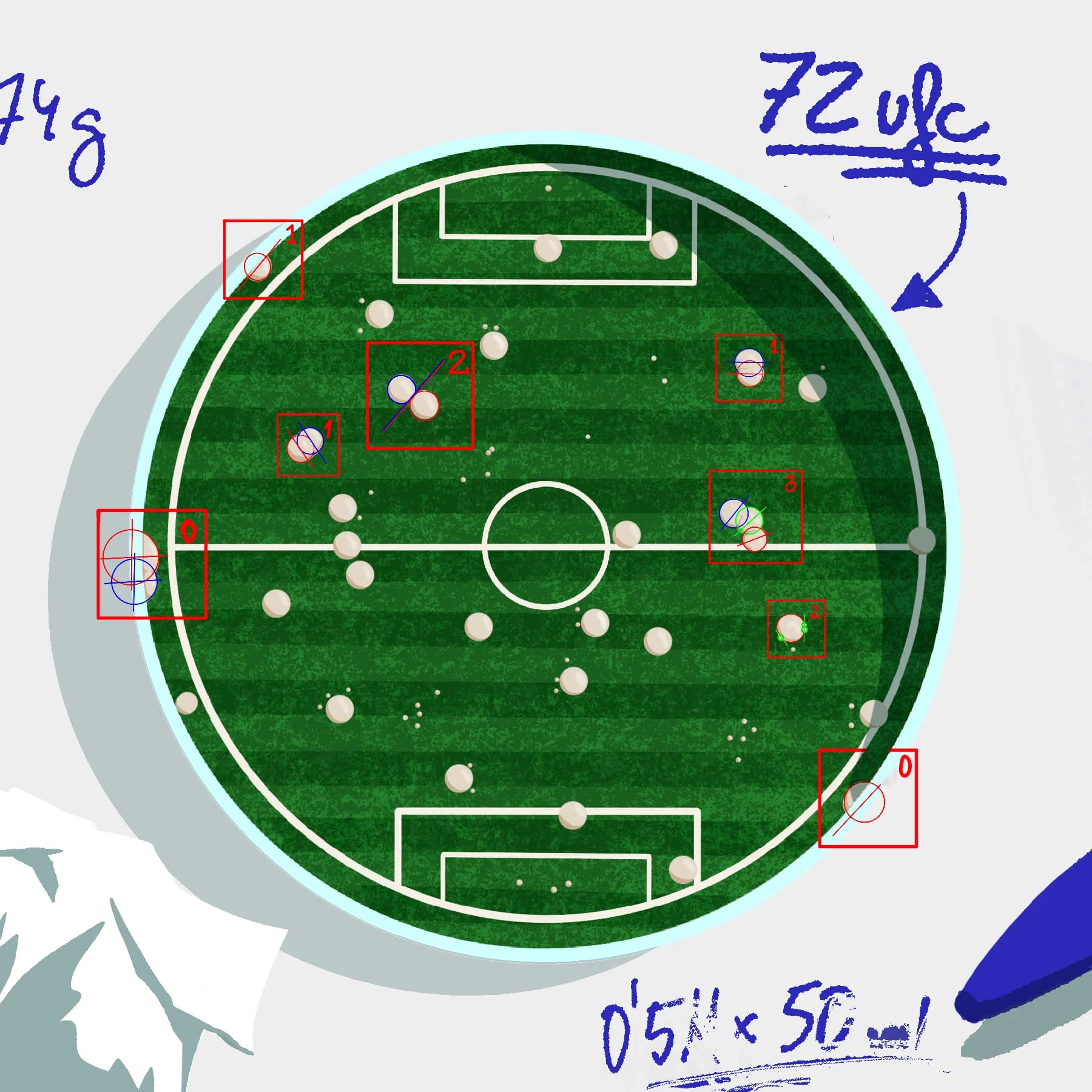
Not because one made an obvious mistake. But because on that plate there were three colonies stuck together that one counted as two and the other as three. A colony slightly touching the edge that José excluded and Marta included. A cluster of small colonies around a large one that Marta interpreted as satellites of the same strain and José as independent colonies. Neither of them was wrong according to their own criteria. The problem is that each had developed theirs separately, in the absence of a standard that defined it precisely.
This article addresses that: what the standard says when nobody has read it carefully, where different international guidelines diverge, and what concrete criteria reduce variability to the extent that the manual method allows.
Subjectivity is not an analyst's defect
Before getting into criteria, it is worth naming the problem clearly.
This percentage may seem small. Applied to a laboratory with high-throughput analysis, it means that a constant and predictable fraction of its results has a source of uncertainty that is not documented, is not in the report, and is not managed as what it is: a characteristic of the method.
Manual colony counting depends on visual judgments that do not always have an objective answer. Factors like eye strain, accumulated experience, angle of illumination, and personal judgment in ambiguous cases generate variability that does not disappear with more training: it simply changes form. A study that analyzed more than 30,000 plate readings in a clinical setting documented 94.5% agreement among analysts for growth level on blood agar—which implies that in roughly one of every twenty readings, two trained analysts obtain different results on the same plate (Glasson et al., 2016, Journal of Clinical Microbiology). Interanalyst counting error has been estimated at around 6.6% under controlled laboratory conditions.
The solution is not to find more precise analysts, because that is impossible. It is to define exactly what is counted and what is not, and apply it consistently.
What the standards say, and where they differ
The first point of friction is in the countable range: the number of colonies per plate considered statistically valid for calculating the result. And here the standards do not say the same thing.
ISO 4833 (parts 1 and 2, pour plating and surface plating techniques) establishes a range of 15 to 300 colonies per plate as valid for aerobic counting in food chain. The FDA Bacteriological Analytical Manual (BAM) uses 30 to 300 for the pour plating method according to USDA/AOAC criteria, while APHA reduces that lower threshold to 25 to 250. For membrane filtration, USP sets 20 to 200.
These differences are not minor. A laboratory applying ISO criteria will accept a plate with 18 colonies as valid; one applying FDA BAM criteria will discard it. On the same sample, with the same dilution, the final result can differ depending on which standard is applied—and in many routine laboratories that choice is not explicitly documented.
The 30-300 range is not arbitrary: it was established as the statistical optimum based on empirical data on precision and bias as a function of colony numbers per plate, and its soundness has been confirmed in several later revisions (Tomasiewicz et al., 1980, Journal of Food Protection). Below 30, sampling error dominates. Above 300, crowding causes colony fusion and systematic underestimation. The standard does not define a range for convenience: it defines it because outside that range the method ceases to be statistically reliable.
The second point of friction is the criteria for non-standard colonies. Here ISO 4833 is the most explicit of commonly used standards, and its criteria are as follows:
Spreading colonies: They are counted as a single colony, regardless of the area they cover. If the spreading affects less than one quarter of the plate, colonies are counted in the unaffected zone and extrapolated to the total. If it affects more than one quarter, the plate is discarded.
Pinpoint colonies: They must be included in the count. The standard is explicit on this point, and also on the associated risk: the operator must examine questionable objects under higher magnification to distinguish real colonies from undissolved agar particles or precipitated matter. Not all small spots are colonies.
Reading conditions: The count is performed under subdued (indirect) light, not under intense direct light. This detail, which rarely appears in laboratory internal procedures, affects the ability to detect small colonies and the perception of contrast between adjacent colonies.
What the standard does not explicitly resolve are the most common cases in practice: two colonies growing in contact without fusing, a colony partially on the plate edge, or a cluster of satellite colonies around a dominant colony. In these cases, interanalyst variability is not a consequence of ignoring the standard, but of the limits of what the standard specifies.
The rows for "colonies on edge," "colonies in contact," and "satellite colonies" appear as "not specified" in all standards. This is not a flaw in the table. It is evidence of a real gap in the regulations, and it is precisely that gap that leads Marta and José to develop different criteria and, with them, divergent results. An internal counting procedure is not optional or bureaucratic: it is the complement that covers what no standard, by design, can cover.
Criteria that reduce variability
Combining regulatory requirements with evidence on sources of interanalyst error, the criteria that have the most impact on counting consistency are the following.
Documented and explicit countable range. The laboratory must define in its internal procedure which standard it applies and what the valid colony range is for each type of analysis. It is not enough to "follow ISO" if it is not written which part of ISO and for which matrix.
Written criterion for colonies in contact. The most widespread rule, and one that best reconciles precision and consistency, is to count as a single colony any pair of colonies that share a visible edge, and as separate colonies those that touch at a single point without edge fusion. What is not acceptable is for each analyst to decide in the moment.
Criterion for colonies on edge. A colony that extends beyond the plate edge by more than half its diameter is excluded. One that barely touches it or crosses it by less than half is included. The criterion must be written.
Criterion for satellite colonies. Satellite colonies—small colonies growing in the halo of inhibition or diffusion of a dominant colony—are counted as independent colonies unless the specific procedure for that microorganism indicates otherwise.
Standardized reading conditions. Subdued indirect light, stable ambient temperature, without accumulated visual fatigue. The time of day and the number of plates already counted before the plate in question are variables that affect counting precision and are almost never controlled.
Analyst record. Each result should be linked to the analyst who performed it. Not as a disciplinary measure, but as a traceability datum that allows detecting systematic deviations between analysts before they generate non-conformances.
The consequences of not having it defined
Interanalyst variability is not an abstract problem. It has concrete consequences that appear in different parts of the laboratory and are rarely connected to each other.
Interlaboratory studies show that reproducibility uncertainty for general aerobic counting between different laboratories ranges from 9.3% to 12.1% on a logarithmic scale when ISO methods are applied correctly. For Enterobacteriaceae that figure rises to 14-17.4%, and for E. coli it reaches between 21.1% and 30.9%. Two laboratories, both applying the method correctly, can obtain results that differ by more than 30% on the same sample without either having committed a visible technical error.
Within the same laboratory, interanalyst variability manifests in analysis repetitions, discrepancies between shifts, and non-conformances whose root cause is not correctly identified. When a non-conformance is opened due to a discrepant result between analysts, the process that follows—cause investigation, corrective action, follow-up—consumes time and resources that were not budgeted. Worse yet: if the identified root cause is incorrect, the corrective action will not resolve the problem.
The most costly scenario is one that leaves the laboratory. Colony count is the datum that determines whether a product meets the microbiological criteria of CE Regulation 2073/2005. An erroneous result that leads to releasing a batch that should not have been released is not an internal error: it is the beginning of a chain whose final cost is difficult to estimate. Studies on product withdrawals from the US market put the average direct cost at around ten million dollars, with serious cases that have eroded more than one hundred million in stock value in days. Microbiological contamination represents, along with allergens, 76% of the total withdrawals recorded in the food sector in the last two decades.
Marta and José, with written criteria
Let us return to the plate from the beginning.
Marta and José still take 70 seconds. Manual counting time does not change with criteria: what changes is what they do with ambiguous cases. The three stuck-together colonies now have a rule: they share a visible edge; they are counted as one. The colony on the edge: it crosses less than half its diameter; it is included. The small colonies around the large one are counted as independent colonies unless the procedure indicates otherwise.
Their results now match. Not because they have improved as analysts. But because they are applying the same criterion to the same object.
That is what a well-defined counting procedure does: it does not eliminate the uncertainty inherent in the manual method, which exists and which the standard documents, but it does eliminate variability that provides no information and only introduces noise into the data.
The difference between a reproducible result and one that depends on who was in the laboratory that day is not in the equipment. It is in whether someone took the time to write down what is counted and what is not.
References
-
Heuser, E., Becker, K. & Idelevich, E.A. (2023). Evaluation of an Automated System for the Counting of Microbial Colonies. Microbiology Spectrum, 11(4):e00673-23. https://doi.org/10.1128/spectrum.00673-23
-
Glasson, J., Hill, R., Summerford, M. & Giglio, S. (2016). Observations on Variations in Manual Reading of Cultures. Journal of Clinical Microbiology, 54(11). https://doi.org/10.1128/JCM.01380-16
-
Tomasiewicz, D.M. et al. (1980). The Most Suitable Number of Colonies on Plates for Counting. Journal of Food Protection. — Empirical basis of the 30-300 range as statistical optimum. https://www.sciencedirect.com/science/article/pii/S0362028X23008669
-
ISO 4833-1:2013 and ISO 4833-2:2013. Microbiology of the food chain — Horizontal method for the enumeration of microorganisms. International Organization for Standardization. — Counting criteria: range 15-300, spreading colonies, pinpoint colonies, reading conditions. https://www.iso.org/standard/53728.html and https://www.iso.org/standard/59509.html
-
FDA Bacteriological Analytical Manual (BAM), Chapter 3: Aerobic Plate Count. — Countable ranges per standard: USDA/AOAC (30-300), APHA (25-250), ISO (15-300). https://www.fda.gov/food/laboratory-methods-food/bam-chapter-3-aerobic-plate-count
-
Commission Regulation (EC) No 2073/2005 of 15 November 2005 on microbiological criteria for foodstuffs. Official Journal L 338, 22.12.2005, p. 1-26. https://eur-lex.europa.eu/legal-content/EN/TXT/?uri=CELEX:32005R2073